
Template Property Types (Beta)
When a QuickAdd template or capture writes front matter, this feature makes sure each value lands as the right Obsidian property type - a real List, Number, or Checkbox - instead of a string that only looks right. You get clean, typed front matter without hand-formatting YAML, so scripts can hand QuickAdd normal JavaScript values and templates stay readable.
What gets converted
Section titled “What gets converted”There are two layers, and only the second one is a beta toggle.
Always on, no setting required. When a script provides a list (array) or object value for a front matter field, QuickAdd writes it as a real Obsidian List or object property through Obsidian’s own YAML serializer. This is what makes templates like the Movie & Series script produce valid front matter out of the box: a returned array of links becomes a List of links instead of broken YAML.
Behind the beta toggle. The setting below additionally converts string
values into typed properties: a comma or bullet-list string becomes a List,
"42" becomes a Number, "true" becomes a Checkbox, and so on. This is the
beta part, because it changes a value’s type based on its contents. It is
disabled by default.
Here is what the string conversion does to a comma-separated author list:
Before:
authors: "John Doe, Jane Smith, Bob Wilson" # Manual string formattingAfter:
authors: - John Doe - Jane Smith - Bob WilsonPlain {{VALUE}} already round-trips numbers, booleans, and dates to the correct
type without any setting. The beta string conversion below mainly adds
comma/bullet-string to List for properties typed as a list.
Turn on string conversion (beta)
Section titled “Turn on string conversion (beta)”List and object handling needs no setting. To also convert string values into typed properties, enable the beta toggle:
- Open Settings → QuickAdd → Advanced (QuickAdd 2.30.0 or later; earlier versions show it on the main QuickAdd tab).
- Toggle “Convert string front matter variables to typed properties (Beta)”.
String conversion is disabled by default for safety.
Walkthrough
Section titled “Walkthrough”1. Set structured data in a script
Section titled “1. Set structured data in a script”Instead of manually formatting data as strings, use native JavaScript types:
// ✅ NEW: Use native data structuresQuickAdd.variables.authors = ["John Doe", "Jane Smith", "Bob Wilson"];QuickAdd.variables.tags = ["research", "ai", "papers"];QuickAdd.variables.metadata = {    rating: 5,    conference: "ICML",    keywords: ["ML", "AI"]};QuickAdd.variables.published = true;QuickAdd.variables.year = 2023;QuickAdd.variables.notes = null;
// ❌ OLD: Manual string formatting (no longer needed)// QuickAdd.variables.authors = "John Doe, Jane Smith, Bob Wilson";
2. Use them in a template
Section titled “2. Use them in a template”Your template syntax stays exactly the same:
---title: "{{VALUE:title}}"authors: "{{VALUE:authors}}"tags: "{{VALUE:tags}}"metadata: "{{VALUE:metadata}}"published: "{{VALUE:published}}"year: "{{VALUE:year}}"notes: "{{VALUE:notes}}"---
# {{VALUE:title}}
Content here...
3. Get perfect property types
Section titled “3. Get perfect property types”With string conversion turned on, the result is properly formatted as Obsidian property types:
---title: "My Research Paper"authors:  - John Doe  - Jane Smith  - Bob Wilsontags:  - research  - ai  - papersmetadata:  rating: 5  conference: ICML  keywords:    - ML    - AIpublished: trueyear: 2023notes:---
# My Research Paper
Content here...
In Obsidian’s Properties view, authors is a List, tags are tags,
published is a Checkbox, and year is a Number. notes is empty. Obsidian
has no property type for nested objects, so metadata shows as raw JSON:
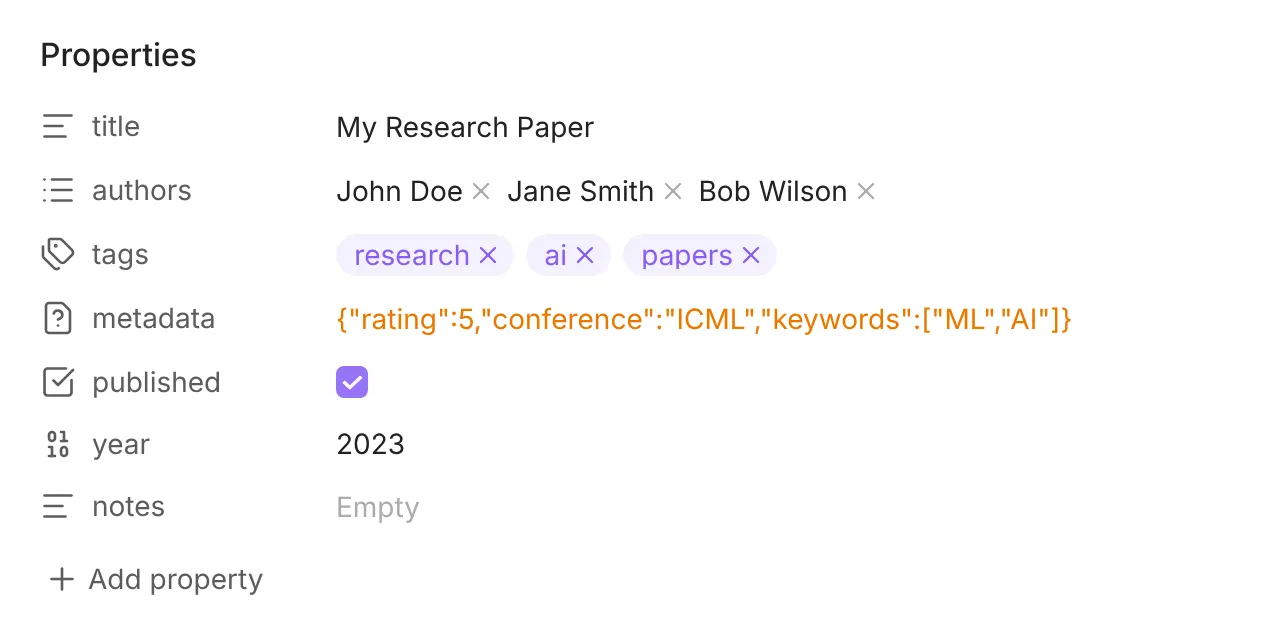
With string conversion off, the lists and the metadata object come out the same
way. Because this template wraps each placeholder in quotes, published,
year, and notes stay quoted strings ("true", "2023", "").
Which JavaScript type becomes which property
Section titled “Which JavaScript type becomes which property”| JavaScript Type | Property Output | Example |
|---|---|---|
| Array | List property | ["a", "b"] → - a- b |
| Empty Array | Empty list | [] → [] |
| Object | Object property | {key: "value"} → key: value |
| Empty Object | Empty mapping | {} → {} |
| Number | Number literal | 42 → 42 |
| Boolean | Boolean literal | true → true |
| Null | Null literal | null → null |
| String | String (unchanged) | "text" → text |
QuickAdd respects the type you set in Obsidian
Section titled “QuickAdd respects the type you set in Obsidian”QuickAdd looks at the type you’ve assigned in Obsidian’s Properties UI for each field and formats the value accordingly:
tags/ multi-select (multitext) / list - strings such asfoo, baror bullet items become proper arrays.- Scalar types (
text,number,date,datetime,checkbox) stay as single values, even if the text contains commas or line breaks. - Unknown type - falls back to the v2.0 behaviour (it will still split obvious arrays like YAML lists or JSON arrays).
This means you can safely type natural prose like Hello, world into a
description prompt without QuickAdd turning it into a YAML list, while
sources marked as a multi-value property will still receive a properly
formatted array.
Nesting goes as deep as you need: objects inside objects, arrays inside
objects, arrays of objects (a project’s
tasks: [{ name: "Research", complete: true }] becomes a list of mappings),
and null leaves all serialize the same way. The worked example below shows a
nested structure end to end.
A worked example: academic papers
Section titled “A worked example: academic papers”One structure from a script, through a template, into typed front matter.
Script:
// From Zotero or other sourceconst paper = {    title: "Attention Is All You Need",    authors: ["Ashish Vaswani", "Noam Shazeer", "Niki Parmar"],    year: 2017,    venue: "NIPS",    keywords: ["attention", "transformer", "neural networks"],    metrics: {        citations: 50000,        pages: [3000, 3010]    }};
Object.assign(QuickAdd.variables, paper);
Template:
---title: "{{VALUE:title}}"authors: "{{VALUE:authors}}"year: "{{VALUE:year}}"venue: "{{VALUE:venue}}"keywords: "{{VALUE:keywords}}"metrics: "{{VALUE:metrics}}"---
# {{VALUE:title}}
## SummaryPaper by {{VALUE:authors}} published in {{VALUE:venue}} ({{VALUE:year}}).
Output:
---title: Attention Is All You Needauthors:  - Ashish Vaswani  - Noam Shazeer  - Niki Parmaryear: 2017venue: NIPSkeywords:  - attention  - transformer  - neural networksmetrics:  citations: 50000  pages:    - 3000    - 3010---
# Attention Is All You Need
## SummaryPaper by Ashish Vaswani,Noam Shazeer,Niki Parmar published in NIPS (2017).
Captures and fresh templates
Section titled “Captures and fresh templates”When a capture choice creates a new file, QuickAdd analyses the just-generated
front matter instead of relying on cached metadata. The capture payload is
inserted after the closing ---, so YAML stays at the top of the note even
on the first run.
For list-style placeholders inside the front matter, QuickAdd resolves the parent property and respects the type you set in Obsidian:
---sources: - "{{VALUE:sources}}"description: "{{VALUE:description}}"---| Property type (in Obsidian) | Behaviour |
|---|---|
multitext, tags, list |
sources becomes a YAML array (- value) using your prompt input. |
text, number, checkbox, date, datetime |
Values remain scalars; commas or line breaks no longer force list formatting. |
Example output:
sources: - [[Episode 1]] - [[Episode 2]]description: This stays a single string, even with commas.Feedback and support
Section titled “Feedback and support”This is a beta feature. It is designed to be safe and backward-compatible, but test it with your own templates before relying on it for important workflows - and when reporting an issue, include the template and the variable data that triggered it.